
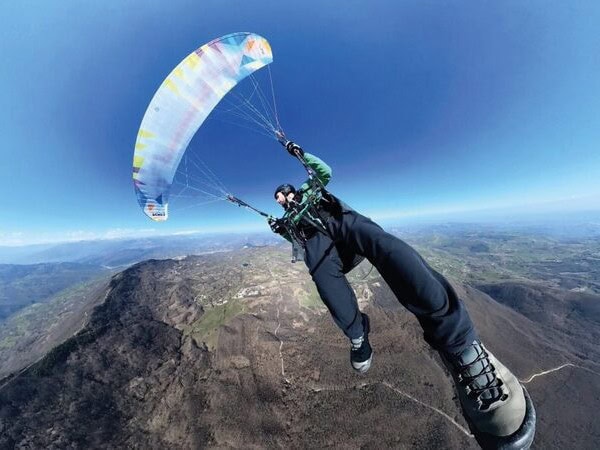
Translated and adapted with permission from an article on Guideslow
Commonly considered an extreme sport suitable for only a few, free paragliding, when performed with adequate technical preparation and in the right weather conditions, is actually a sport accessible to all, practiced, as the word itself suggests, along the slopes of hills and mountains.
It is without a doubt the lightest and most economical device available for flying, as a bag weighing around 10 kilos can accommodate everything needed to observe the world from above: wing, harness, instruments, helmet, and emergency parachute.
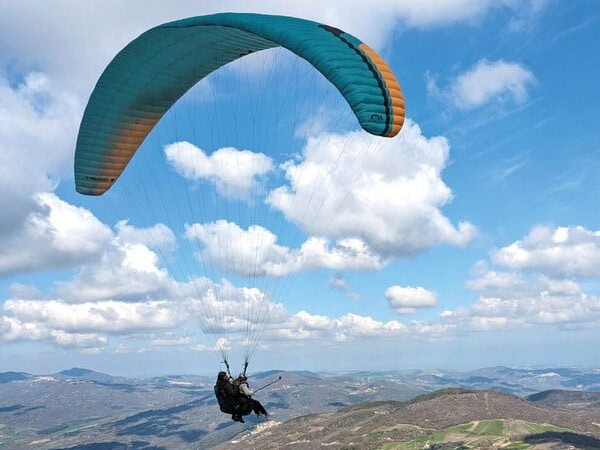
For takeoff, all that’s needed is a small, unobstructed space, and after a short run, perhaps aided by a light breeze, the flight begins. To maneuver and direct the paraglider in the desired direction, two handles called “brakes” are used. This particular means of flight is derived from the more well-known parachute used for airplane launches and was conceived by French paratroopers who felt the need to reduce the cost of their training and no longer depend on airplanes. To complete a paragliding flight, a difference in altitude of a few hundred meters is sufficient, and by exploiting thermals, one can cover long distances and reach very high altitudes, even several thousand meters.
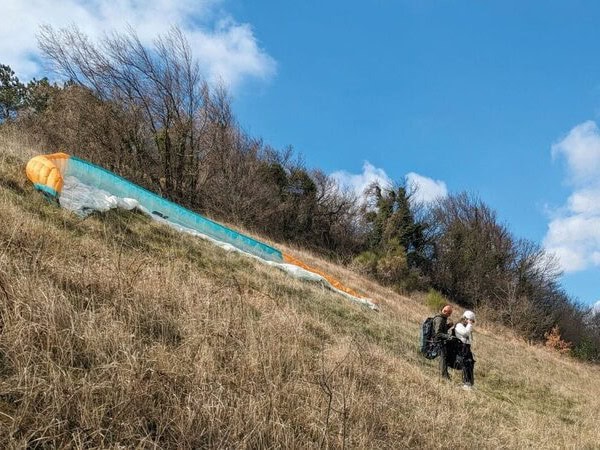
The sail is constructed from a particularly robust ripstop nylon, while the lines are made of Kevlar or Dyneema, two highly resistant and inelastic materials. Given the ease of learning the piloting techniques and the simplicity of using the craft, it can be said that this sport is accessible to everyone and requires no particular physical ability. However, it is still a flying discipline and therefore requires a series of skills, such as immersing oneself in a three-dimensional space (the air) and the ability to correctly execute maneuvers and correlate them with a precise flight plan. The practice of this fascinating sport is dependent on the presence of a difference in altitude and a light “headwind,” which is why mountains are the ideal starting point.
In Molise, a region particularly suited to this sport, the Mainarde and Matese mountain ranges, along with the mountains near the towns of Frosolone and Montefalcone nel Sannio, represent the perfect setting for teaching and practicing this discipline. Throughout the year, instructors certified by Aero Club Italia organize personalized flight courses tailored to the abilities and aptitude of each student. For those who want to experience the thrill of the air, tandem flying with a certified pilot is undoubtedly the simplest and most enjoyable way to enjoy a unique experience, letting the wind caress you and observing the world from a new perspective while sitting comfortably in a harness. Once in the air, the passenger can try piloting, experiencing firsthand how easy it is to control the craft.
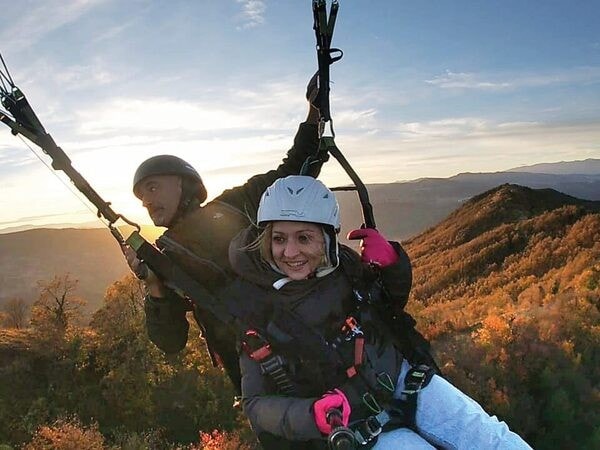
Among the most popular locations for tandem flights is Montefalcone nel Sannio, on the border between Abruzzo and Molise, a stunning 1,000-meter slope offering 360-degree views of the sea, mountains, and lakes. Here, by contacting the Aero Club “I Picchi” association, you can experience the thrill of flight in complete safety, guided by experienced and experienced pilots.
The “I Picchi” club was founded in 1980, initially for hang gliding, and then for paragliding in 1988. In 2001, the club became the ASD Aero Club “i Picchi” with its own flight school certified by the Aero Club d’Italia.