
What does a sustainable food system actually look like?
The answer changes depending on where you stand. At the headquarters of the United Nations Food and Agriculture Organization in Rome, the view stretches across countries and continents. At an urban farming cooperative, it might begin with biodiversity and access to land. In Molise, it can look like an olive grove cultivated for centuries, a farmer milling wheat into flour for pasta, a social cooperative using agriculture to build bridges between cultures, or a small producer trying to connect more directly with the people who eat what they grow.
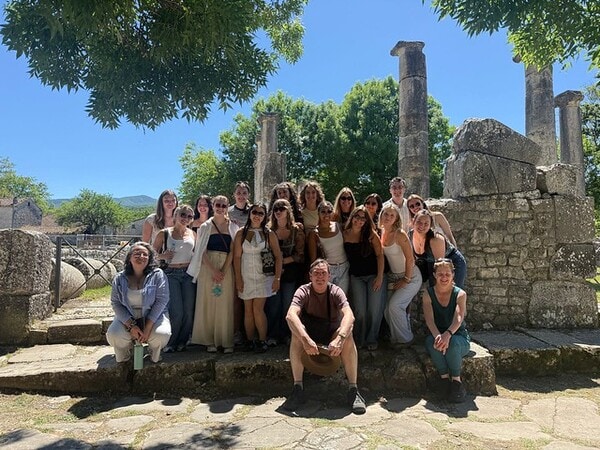
This summer, 17 students from the University of Wisconsin–Madison College of Agricultural and Life Sciences, led by Professors Geoff and Kirstin Siemering, spent fifteen nights exploring those connections through UW’s Sustainable Food Systems in Italy faculty-led program. Traveling from Rome to Campobasso and Termoli, students examined food systems at nearly every scale, from international policy and public health to agricultural research, food access, farming, processing, distribution, and the choices we make around the table.
Food Systems at the Global and Local Level
The program began in Rome with a question much larger than any individual farm or meal: Who has the right to food, and how do we build systems capable of delivering it?
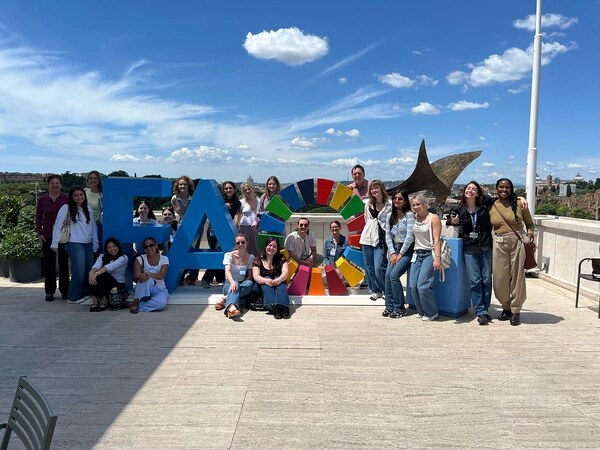
At the Food and Agriculture Organization of the United Nations (FAO), students visited the Right to Food office and later attended two days of UN Nutrition Week, hearing from experts working at the intersection of nutrition, food security, policy, and sustainable development. They also visited a Caritas food pantry through the Rome Food Policy Council, moving in a single day from conversations about global food security to the realities of getting food into the hands of people who need it within one city.
That movement between scales continued throughout their week in Rome.
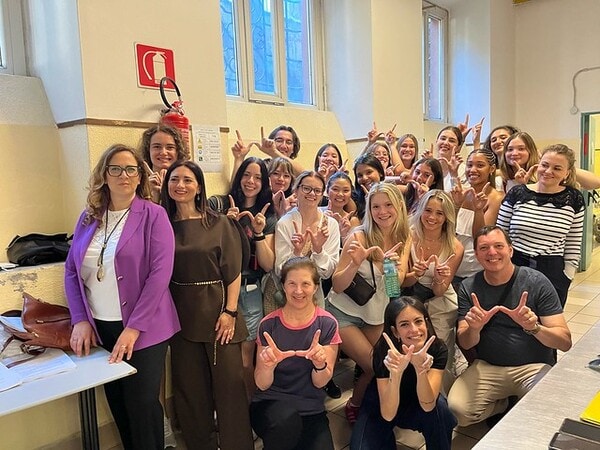
At a public school cafeteria, students observed meal preparation and service and explored how nutrition and sustainability become part of everyday institutional decision-making. A food and archaeology tour with food writer Katie Parla traced questions of agriculture, trade, regulation, imports, waste, and consumption through thousands of years of Roman history. At CREA‘s research farm, students encountered current research into sustainable agriculture, soil fertility, biodiversity, food science, technology, and the circular bioeconomy.
Then, at Co.r.ag.gio, those ideas returned to the soil. The youth-led agricultural cooperative combines organic production with education and environmental stewardship, growing vegetables, cereals, more than 50 varieties of fruit, olives, and organic honey while exploring how agriculture can contribute to Rome’s urban food system.
Even ancient Rome joined the conversation. At Ostia Antica, the former port city became a classroom for considering how food moved through the Roman Empire, reminding students that questions about production, transportation, trade, and access are hardly new.
Sustainability Is Complicated
One of the strengths of the program is that sustainability is never presented as a single practice or easy answer.
At the Evoo School Foundation, students examined threats and opportunities facing olive cultivation, including Xylella fastidiosa, before learning to recognize the qualities of extra virgin olive oil through guided tasting. At Italy’s National Institute of Health, the lens widened again through a One Health approach connecting sustainable agriculture and food safety with human, animal, and environmental health.
Then came Molise, where many of those big questions became intensely local.
At Azienda Agricola Principe Pignatelli in Monteroduni, students walked among a landscape where olive cultivation stretches back centuries and discussed contemporary production with an expert agronomist. Nearby, Claudio Papa of Nutfruit Italia introduced another agricultural story: efforts to encourage and expand Italian almond production.
By evening, students were in the mountain village of Pesche making pizza at Bas & Co, following the process from grain selection and milling through slow fermentation and the use of artisanal, locally rooted ingredients.
Sustainability, they were discovering, lives everywhere along the chain.
Following the Food
Campobasso offered the chance to follow that chain in several directions.
Students met with the city’s Deputy Mayor and Food Policy Council before heading into the forests around Busso to hunt truffles with Di Iorio Tartufi. The practice connects ecology and economy with a cultural tradition recognized by UNESCO as intangible cultural heritage. Later that day, the scale was to change dramatically at La Molisana, where students would have seen (were it not for a technical problem at the factory that prevented the group’s visit) how Italian durum wheat and local spring water move through an integrated production system to become pasta distributed far beyond Molise.
The next day brought the focus back to farms. At Azienda Agricola Alba, students made cheese, explored an educational organic garden and olive grove, and discussed sustainable farming on a smaller scale. At Azienda Agricola Primo Sole, they followed wheat through its own local journey, walking the fields, discussing cultivation techniques and varieties, visiting the stone mill and pasta factory, and finally tasting pasta made with local ingredients.
Field to mill. Mill to pasta. Pasta to plate.
In a classroom, that is a supply chain.
Here, students could walk through it.
Food as a Social System
But food systems are not only environmental and economic systems. They are human ones.
That became especially visible at Fattoria Griot, a natural agricultural farm and social cooperative near Bojano. Students toured its gardens and greenhouses and got their hands into the work through transplanting, weeding, and irrigation. But the farm’s mission reaches beyond organic production. Its work also centers cooperation among people from different cultural backgrounds and challenges stereotypes that can stand in the way of an intercultural society.
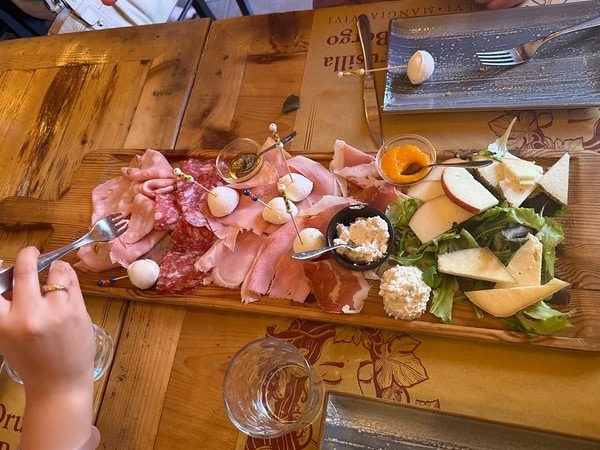
Even lunch illustrated the model: a table assembled from ingredients supplied by the farm and a network of small local producers, from cheeses and vegetables to eggs, olive oil, meats, breads, and pastries.
Later in the program, Azienda Agricola Emilia Martino offered another perspective on the relationships connecting producers and consumers. Through Biorfarm, students explored a digital agricultural community designed to strengthen the position of small organic farmers, reconnect consumers with nature and food production, and support greater environmental and social sustainability. The visit also opened an important conversation about migrant agricultural workers and advocacy, placing the people whose labor sustains food systems squarely within discussions of sustainability.
Because a food system cannot really be sustainable if we consider the land but forget the people working it.
Preserving Place While Looking Forward
The final days in Lower Molise brought many of the program’s threads together.
At Agriturismo Steiger-Kalena in Casacalenda, students explored a sustainable organic winery producing handcrafted wines from varieties including Tintilia, Montepulciano, and Aglianico, followed by a lunch featuring products from Molise Farm’s network of small local producers.
In Termoli, meanwhile, sustainability met the sea. A tour with Fiorenza Grilli of Turismol introduced students to the coastal city’s culinary heritage, where the local fish market and dishes such as brodetto alla termolese reflect generations of dependence upon the Adriatic and its seasonal catch.
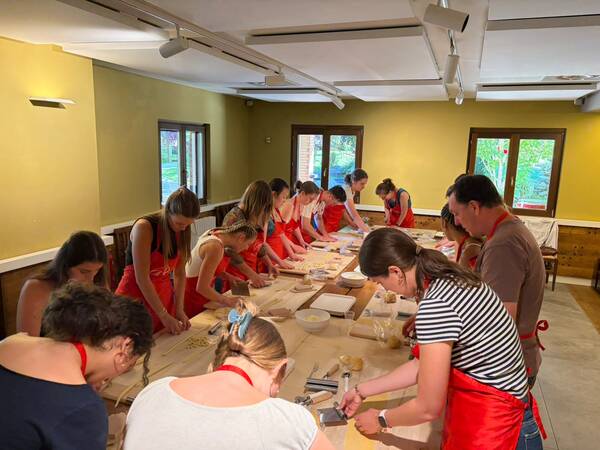
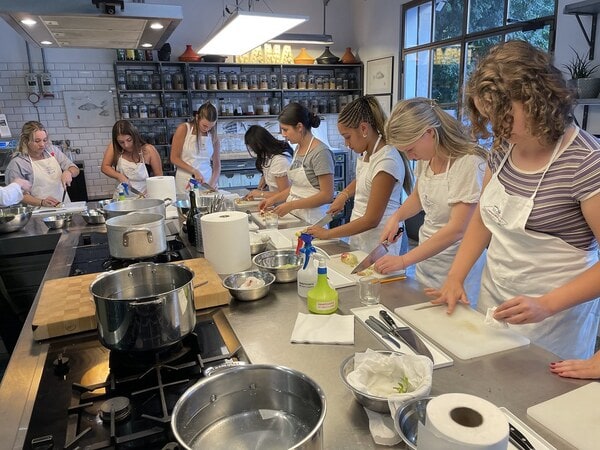
Along the way, students also explored the Saturday market in Bojano, visited the Roman city of Saepinum, made fresh pasta alongside Chef Marianna Romano at Masseria Ceccone, cooked at MaMà Mediterraneum in Rome, tasted olive oil and truffles, made cheese and pizza, wandered Italian markets, and had time to experience Rome and the Adriatic coast beyond the academic itinerary.
Those moments matter, too.
A sustainable food system is ultimately about more than producing enough food with fewer environmental costs. Food carries memory and identity. It creates livelihoods and gathering places. It shapes landscapes, public health, daily rituals, and relationships. And sometimes understanding that requires sitting around a table long enough to notice.
From the Students Themselves
Perhaps the best measure of experiential learning is what students carry home.
In her reflection for UW–Madison, Camryn Anderson remembered the visit to the Roman elementary school as a moment when Italian culture and the academic focus of the program came together. She was struck both by the hospitality the group received and by the care devoted to seasonal, nutritious school meals—an experience she connected directly to her future professional interests.
For Anya Mullen, attending UN Nutrition Week at FAO was a highlight that broadened how she imagined a future career addressing nutrition and food insecurity. But another lesson followed her home as well: the Italian practice of treating meals as time for connection rather than something to hurry through.
Their stories are a reminder that the learning doesn’t end when the itinerary does.
Read more UW Sustainable Food Systems in Italy student stories
Partners
A program spanning fifteen nights, three cities, international institutions, research centers, farms, cooperatives, kitchens, markets, archaeological sites, and countless conversations only works because people are willing to share not simply their products, but their knowledge.
Throughout Rome and Molise, researchers, policymakers, farmers, food producers, chefs, advocates, guides, public officials, and community organizations invited students behind the systems they were studying. They allowed participants to ask questions, get their hands dirty, taste the results, and encounter competing ideas about what a more sustainable food future might look like.
Molise Italian Studies’ local team supports those connections throughout the experience, helping bridge the many communities, people, and places that turn an ambitious itinerary into a living classroom.
Over fifteen days, students encountered the food system from an extraordinary number of vantage points: international policy and local governance; research and tradition; industrial production and small farms; soil and sea; food security and public health; environmental stewardship and labor; ancient trade routes and digital agriculture.
What emerges is not one definition of a sustainable food system.
It is a better set of questions about how we might build one.
Sound like something your students would like to experience? Email us or visit our Faculty-Led page.
And it’s not just for university students. Want us to set up an Adult Study Abroad with this itinerary? We can’t wait to hear from you!