
Translated and adapted with permission from an article on Guideslow
A Leap into the Prehistory of Molise
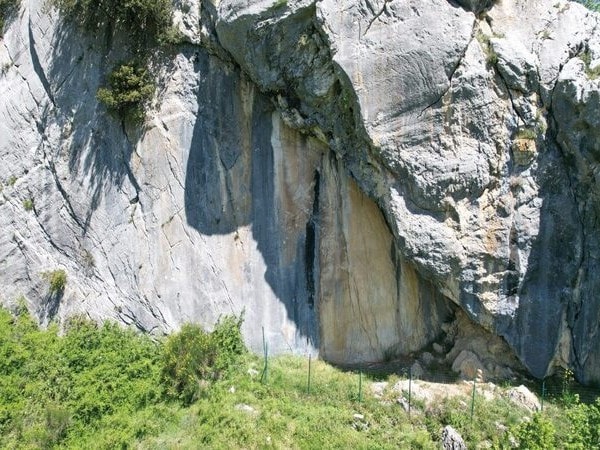
In the municipality of Civitanova del Sannio, in the Pietra Spaccata area and near the Lucera-Castel di Sangro sheep track, is the Morricone del Pesco’s Il Riparo, a rock refuge surrounded by broom bushes, very yellow and fragrant in spring, where some of the oldest rock paintings in Molise are preserved.
It is an imposing testimony to the millennia-old presence of man in this region; a “magical” place that to an imaginative observer can appear, depending on the vantage point, a stone monster, a whale, or a dinosaur whose head rises up to emerge from the great curve of the road that climbs towards the hill.
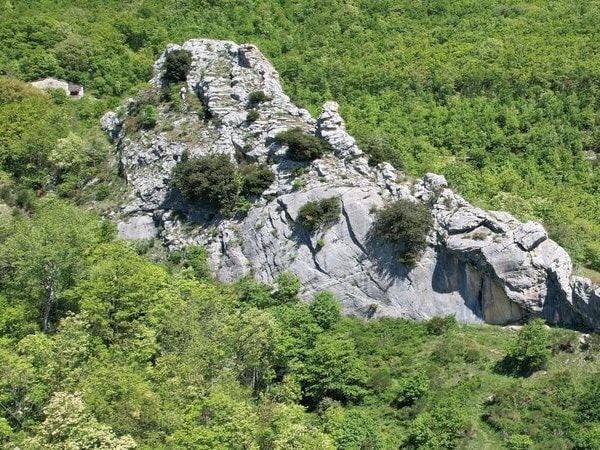
The smooth rock walls are the result of the action of ice and natural elements; the smooth surface is composed of marl, a limestone and clay rock dating back to the Miocene (between approximately 23 and 5 million years ago). Traces of paintings and engravings have been identified on these walls, offering a glimpse into the more distant past, dating back to the late Upper Paleolithic (35,000–10,000 years ago) and the Iron Age (950–720 BC). The paintings are made with charcoal and hematite, while the engravings are made with tools similar to metal chisels.
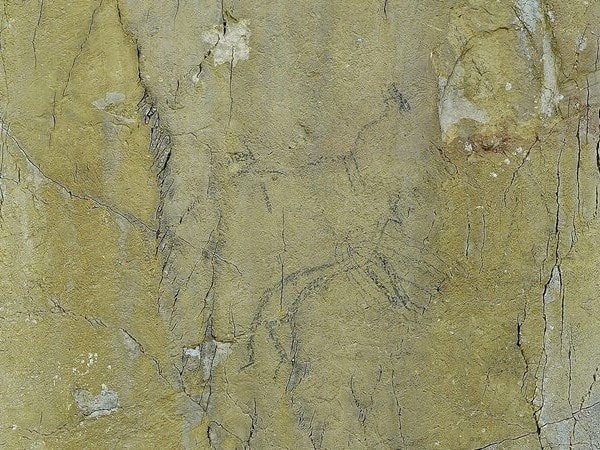
The identified and recognized images are diverse and can be grouped into various categories: anthropomorphic, geometric, zoomorphic, simple groups of lines, and other unidentifiable figures. Their discovery occurred only in 2011 thanks to Guido Lastoria, a resident of Civitanova del Sannio, arousing enthusiasm and interest from the scientific community, so much so that they have been the subject of study and research by the archaeological cooperative “Le Orme dell’Uomo” together with the University of Ferrara.
The research revealed that the Morricone del Pesco shelter is the first evidence of rock art in Molise, and its discovery has enriched the list of prehistoric sites in Central and Southern Italy.
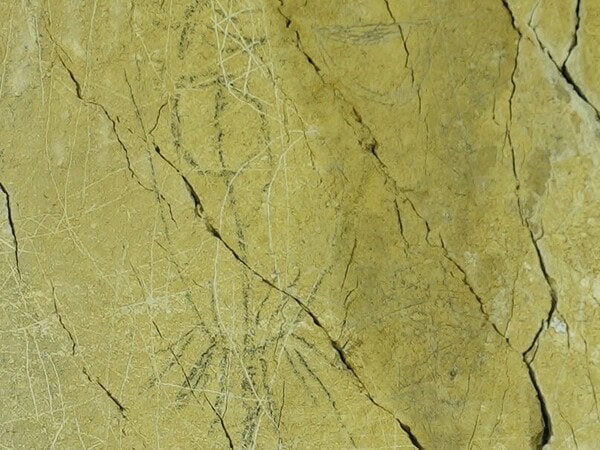
The Morricone del Pesco shelter, with its paintings and engravings, represents an important monument of prehistoric art, a place to be appreciated and admired not only for its historical and cultural value but also for the evocative landscape surrounding it. For further information, we recommend reading the scholarly articles easily found online.