
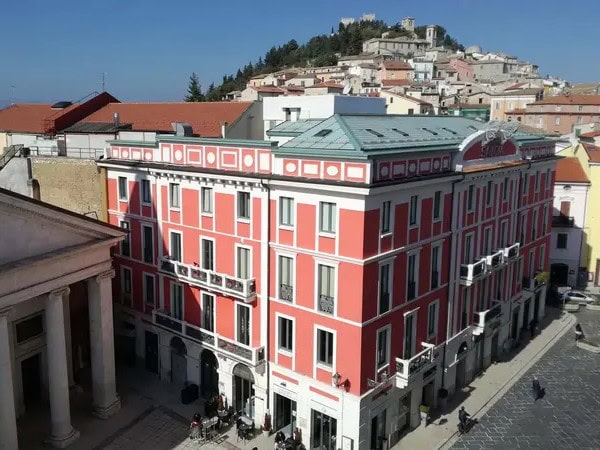
Molise has 136 municipalities (comuni). This month Mootilda maps Campobasso, where old Molise meets the modern city.
Climbing from an elegant 19th-century city center to a medieval borgo crowned by Castello Monforte, Campobasso reveals a side of Molise that is at once historic, urban, and unmistakably local. As the regional capital, it is home to government offices, the University of Molise, museums, theaters, restaurants, and the passionate supporters of the Campobasso Lupi. Yet climb the narrow streets toward the castle and another city emerges: ancient churches, stone houses, hidden stairways, and traditions that have survived for centuries. Campobasso may be Molise’s administrative center, but its real appeal lies in the layers waiting to be discovered between the city below and the hill above.
Location & Physical Geography
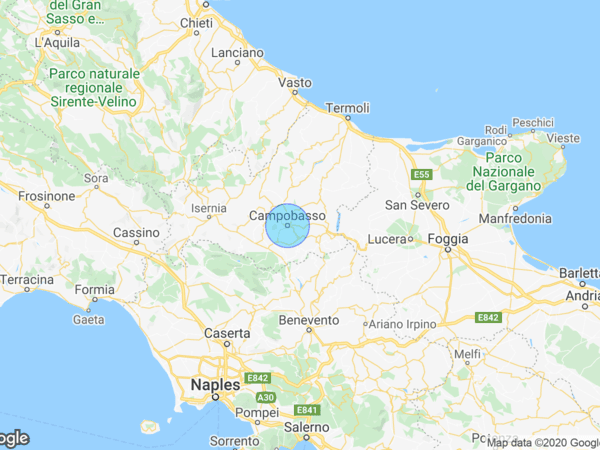
Campobasso sits near the center of Molise, between the valleys of the Biferno and Fortore rivers and surrounded by the rolling hills and mountains that characterize the region’s interior.
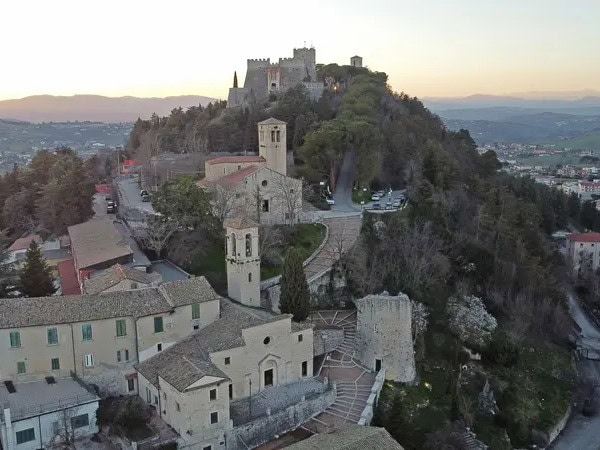
The city itself unfolds across two distinct landscapes. The oldest neighborhoods climb Montebello, or Monforte Hill, where the medieval borgo rises toward Castello Monforte at roughly 790 meters (2,590 feet) above sea level. Below it spreads the more spacious modern city, characterized by broad streets, piazzas, gardens, civic buildings, shops, and cafés.
That contrast is one of Campobasso’s defining features. Visitors can begin among elegant avenues and green spaces and, within minutes, find themselves ascending steep stone lanes toward a medieval castle with sweeping views across the Molisan landscape.
As the capital of both the Province of Campobasso and the Region of Molise, the city also serves as the region’s principal administrative and institutional center.
Historical Overview
Campobasso’s story begins long before the modern city. Archaeological traces of Samnite fortifications survive on Montebello, evidence of settlement in the surrounding territory before Roman expansion.
The development of Campobasso itself is generally traced to the Lombard period, with references dating to the ninth century. Even the origin of its name remains part of the city’s story. Several explanations have been proposed, but one of the most widely accepted derives Campobasso from Campus Vassorum, referring to an area inhabited by artisans.
Under the Normans, Campobasso grew in importance, expanding around churches including San Bartolomeo and San Mercurio. Its medieval development reached a high point under Nicola II Monforte, or Cola Monforte, during the 15th century. He strengthened the city walls and gates and reconstructed the castle following the devastating earthquake of 1456. Six historic gates, represented today by six towers on Campobasso’s coat of arms, once controlled access to the fortified city.
Campobasso eventually passed through several noble families before its inhabitants freed themselves from feudal control in the 18th century.
A new chapter began after the destructive earthquake of 1805. Campobasso became capital of the Province of Molise in 1806, and in 1814 Gioacchino Murat, King of Naples, authorized construction beyond the medieval walls. Architect Bernardino Musenga designed a new city characterized by broad, orderly streets, modestly scaled buildings, piazzas, and abundant green space.
That expansion created the contrast still visible today between the tightly woven medieval city on the hill and the more open Borgo Murattiano below.
Campobasso also experienced significant destruction during World War II. Canadian forces occupied the city during the Allied advance in October 1943, and the prolonged military presence led to Campobasso becoming known among Allied troops as “Canada Town” or “Maple Leaf City.”
Today, Campobasso remains Molise’s political and administrative capital while serving as an important center for education, culture, commerce, and contemporary regional life.
What to See & Do
Climb Through the Historic Center
The best way to understand Campobasso may be simply to start walking uphill.
The narrow streets and stairways of the historic center wind past stone houses, medieval churches, arches, surviving city gates, and tiny piazzas as they climb toward Castello Monforte. Along the way, visitors encounter some of the oldest parts of the city and increasingly expansive views over modern Campobasso below.
Look for Porta Mancina and Porta Sant’Antonio Abate, surviving reminders of the medieval walls that once enclosed the borgo.
Visit Castello Monforte
Standing at the summit of Monforte Hill, Castello Monforte is Campobasso’s defining landmark.
A fortification existed here centuries earlier, but the castle assumed much of its present appearance under Cola Monforte following the earthquake of 1456. Its austere stone walls still dominate the city skyline.
The climb is rewarded with sweeping views across Campobasso and the surrounding Molisan countryside
Discover Campobasso’s Historic Churches
The climb toward the castle also passes several of Campobasso’s most important churches.
San Giorgio, dedicated to the city’s patron saint, is among its oldest. Nearby San Bartolomeo preserves striking Romanesque features, while San Leonardo sits farther down the historic center.
Near the castle, Santa Maria Maggiore, also known as the Madonna dei Monti, contains works by Campobasso-born painter Amedeo Trivisonno and a 14th-century wooden statue of the Madonna.
In the lower city, the Cathedral of the Santissima Trinità represents another chapter in Campobasso’s religious and architectural history.
Explore the Museo Sannitico
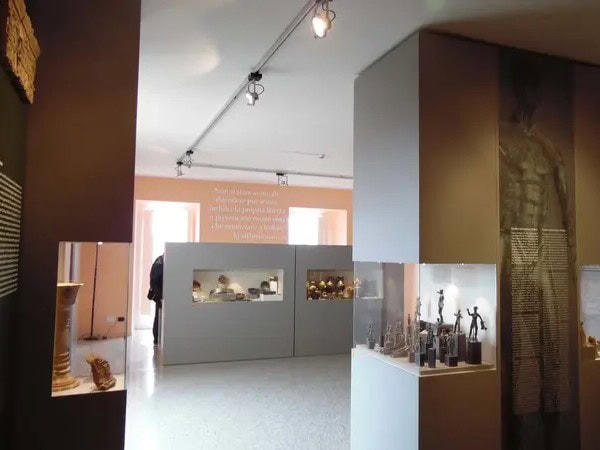
Housed inside historic Palazzo Mazzarotta, the Museo Sannitico offers one of the city’s best introductions to the ancient peoples who inhabited this part of Italy.
Its archaeological collections illuminate Samnite life and the cultures that shaped Molise before and during Roman expansion, providing valuable context for archaeological sites visitors may encounter elsewhere throughout the region. Don’t miss a 4th century BC Samnite panoply–complete with breastplate, ankle guards, and warrior belts–donated by Molise Italian Studies alum David Romano!
Go Behind the Scenes at the Museo dei Misteri
Even if your visit does not coincide with Corpus Domini, you can experience Campobasso’s most extraordinary tradition at the Museo dei Misteri.
The museum preserves the remarkable Ingegni designed by 18th-century Campobassano sculptor Paolo Saverio Di Zinno: wooden bases supporting complex iron structures that carry living performers high above the streets during the annual procession.
Seeing the machines without their costumes and performers offers an entirely different appreciation for the engineering, artistry, and craftsmanship behind the spectacle.
Stroll Through the Borgo Murattiano
After exploring the medieval city, head downhill into the Campobasso that emerged during the 19th century.
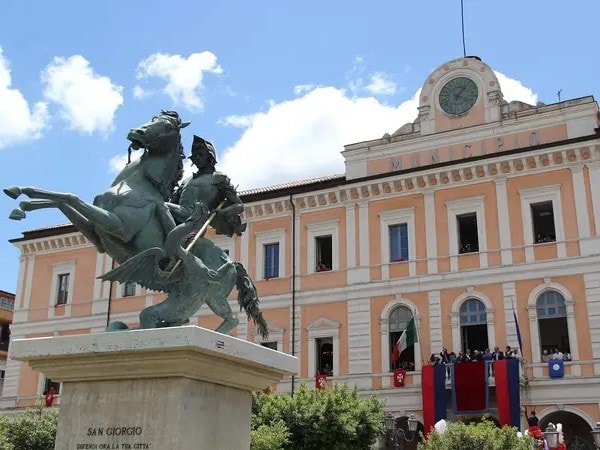
The Borgo Murattiano encompasses broad streets and civic spaces around Corso Vittorio Emanuele II and Piazza Vittorio Emanuele II, where Palazzo San Giorgio, the city hall, stands. Nearby landmarks include the Teatro Savoia, Palazzo del Governo, and other buildings reflecting Campobasso’s development as a regional capital.
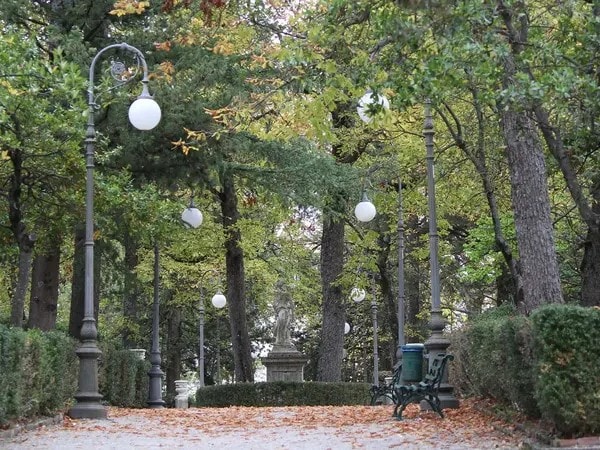
Continue toward Villa de Capoa, an elegant historic Italian garden that offers a leafy retreat from the city streets.
Experience University Life at UniMol
Campobasso is also home to the principal campus of the Università degli Studi del Molise (UniMol).
Founded in 1982, the university brings students, researchers, and international visitors into the city and adds another dimension to Campobasso’s role as the intellectual and institutional center of contemporary Molise. UniMol has also partnered with MIS to offer a customized intensive Italian language course.
Run With the Wolves
In Campobasso, Lupi means more than the animal associated with Molise’s mountains.
The Campobasso Football Club, nicknamed the Lupi, has roots stretching back to 1919 and a fiercely loyal local following. The club currently competes in Serie C and plays at the Stadio Antonio Molinari.
Its latest chapter has brought Campobasso unexpected attention from across the Atlantic. Italian-American entrepreneur Matt Rizzetta leads the ownership group, which also includes American television personalities Kelly Ripa and Mark Consuelos as minority investors.
Catching a match offers visitors something monuments cannot: a chance to experience contemporary Campobasso at full volume.
Traditions
- I Misteri
- On Corpus Domini, Campobasso becomes the stage for one of Molise’s most extraordinary traditions: the Processione dei Misteri.
Its origins reach back to medieval sacred representations, but the spectacle seen today owes its form to Campobasso sculptor Paolo Saverio Di Zinno, who was commissioned in the mid-18th century to design elaborate processional machines known as Ingegni.
Each consists of a wooden base supporting an ingenious iron framework upon which costumed participants, many of them children, become saints, angels, devils, and other figures from sacred scenes. As teams of bearers carry the enormous structures through the streets in carefully synchronized steps, the frameworks sway and the performers appear to float above the crowd.
Di Zinno created eighteen surviving documented machines; six were destroyed during the earthquake of 1805. Twelve continued the tradition, and a thirteenth was added in 1959 based on a design attributed to Di Zinno.
The result is part procession, part engineering marvel, part theater, and entirely Campobassano.
The tradition lives throughout the year at the Museo dei Misteri, but on Corpus Domini the Ingegni belong to the streets, surrounded by generations of families who continue to carry, perform, prepare, watch, and pass the tradition forward.
- On Corpus Domini, Campobasso becomes the stage for one of Molise’s most extraordinary traditions: the Processione dei Misteri.
- Other Traditions
- Campobasso’s cultural calendar extends well beyond Corpus Domini. The Infiorata associated with the Madonna dei Monti fills streets with floral designs, while the Good Friday procession is accompanied by hundreds of singers performing Teco Vorrei through the city.
In November, the Su e Giù noncompetitive race sends thousands of participants up and down Campobasso’s famously hilly streets—a particularly fitting celebration for a city whose geography is built around climbing.
- Campobasso’s cultural calendar extends well beyond Corpus Domini. The Infiorata associated with the Madonna dei Monti fills streets with floral designs, while the Good Friday procession is accompanied by hundreds of singers performing Teco Vorrei through the city.
Tastes
Campobasso’s cuisine is rooted in the resourcefulness of inland Molise: grains, vegetables, pork, cheese, handmade pasta, and recipes designed to turn modest ingredients into deeply satisfying food.
Among the dishes to seek out are:
- Pizza e minestra, a foundational dish combining cornmeal pizza with cooked field greens
- Cavatelli, traditionally served with rich pork ragù
- Taccozze e fagioli, handmade pasta with beans
- Pallotte cacio e ova, balls of cheese and egg
- Torcinelli, rooted in Molise’s pastoral traditions
- Caponata campobassana, traditionally made with biscuits dressed with oil and vinegar and topped with ingredients including tomatoes, olives, and hard-boiled eggs
And save room for dessert.
Campobasso is particularly associated with Milk Pan, a dome-shaped cake flavored with Milk liqueur and covered with a hazelnut-and-chocolate coating. Other local sweets include mostaccioli, while traditional liqueurs such as Poncio and Crema Milk offer another distinctly Campobassano finish.
Where to Eat & Drink
- La Grotta di Zì Concetta
- If you want to understand Campobassana cooking, start here.
Tucked into the historic center near Porta Mancina, this family-run trattoria serves the kind of food that makes simplicity look deceptively easy. Pizza e minestra, pallotte cacio e ova, vegetables, sausages, caciocavallo, and other dishes rooted in Molise’s cucina contadina make La Grotta di Zì Concetta less a trendy interpretation of local food than an opportunity to simply eat it.
- If you want to understand Campobassana cooking, start here.
- Monticelli Sapere e Sapori
- Another excellent choice for exploring Molisan ingredients and traditions, with a more contemporary approach that still keeps the territory firmly at the center of the plate.
- Another excellent choice for exploring Molisan ingredients and traditions, with a more contemporary approach that still keeps the territory firmly at the center of the plate.
- Miseria e Nobiltà
A welcoming option combining traditional Molisan flavors with more modern preparations, along with pizza and an extensive menu that makes it a good choice for a relaxed evening in the city.
- Anima Caffè
- A small-batch artisan roastery featuring a retail shop, a tasting area, and a wide range of coffees—including specialty coffees, fine Robustas, blends, and single-origin beans.
Something Especially Interesting
A Capital Built in Layers
Campobasso rewards visitors who resist thinking of it as simply Molise’s “big city.”
Start at the castle and walk downhill and you can almost read its history geographically: medieval fortifications and churches give way to the planned 19th-century city, then to the university, stadium, businesses, neighborhoods, and institutions of contemporary Molise.
The city did not replace its past as it grew. It simply kept building below it.
Campus Vassorum: A City of Makers
There is something particularly fitting about the theory that Campobasso’s name derives from Campus Vassorum, the place where artisans lived.
Centuries later, Campobassano craftsmanship produced the ingenious iron structures of the Misteri, and that artisan identity has not disappeared. Wander Strada Orefici in the historic center and you’ll find a street whose very name recalls generations of goldsmiths and craftspeople, with artisans still working in wood and jewelry today.
It is a small but wonderful reminder that Campobasso’s historic center is not simply something to look at. People still make things here.
And sometimes you encounter that spirit of craft somewhere much more ordinary.
For us, one such place is Styling Uomo Gianluca, where Scott once received one of the best haircuts of his life. Not every memorable travel experience needs a museum label.
Mootilda’s Take 🐄
Campobasso is easy to underestimate if you arrive expecting a regional capital to tell its story all at once. It doesn’t. You have to climb for it. Follow a staircase into the old city, duck into a trattoria, look closely at the ironwork holding an angel in the air, hear thousands of voices at a Lupi match, or simply sit with a coffee while the city moves around you. Campobasso reminds us that Molise isn’t preserved behind glass. This is a place where the region goes to school, goes to work, goes out to dinner, cheers, creates, argues, celebrates, and keeps becoming.
References
- GuideSlow. (n.d.). Campobasso. GuideSlow
- Turismo in Molise. (n.d.). Campobasso, la città dei Misteri. Turismo in Molise
- Città di Campobasso. (n.d.). La storia. Comune di Campobasso
- Istituto Centrale per il Patrimonio Immateriale. (n.d.). Corpus Domini a Campobasso. Italian Ministry of Culture – ICPI
- Ministero della Cultura. (n.d.). Museo dei Misteri. Italian Ministry of Culture
- Wikipedia contributors. (n.d.). Campobasso. Wikipedia. English article
- Wikipedia contributors. (n.d.). Campobasso. Wikipedia, L’enciclopedia libera. Italian article
- Made in South Italy Today. (n.d.). Campobasso. Made in South Italy Today
- Photos by Paolo Pasquale