
Translated and adapted with permission from an article on Guideslow, with photos by Nicola Di Stefano
Surrounded by forests that hold age-old secrets, the sanctuary of Castelpetroso stands nestled among the mountains like a precious jewel. For centuries, it has also been the beating heart of Marian devotion.
The Legend
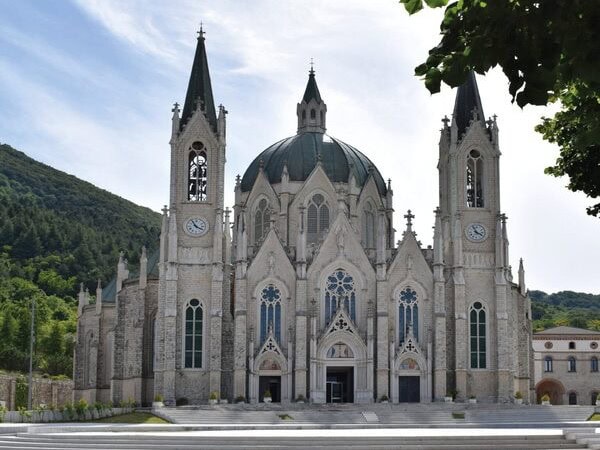
Legend has it that, during a rainy night, the Madonna appeared in the countryside of Castelpetroso to two young peasant girls. At the site of the first of many apparitions, on September 28, 1890, the cornerstone of one of the most beautiful sacred buildings on our peninsula was laid: the Basilica Minore dell’Addolorata. This astonishing structure resembles an ancient fairytale castle, with soaring spires and towers that reveal all the charm of the neo-Gothic style. The Basilica’s design saw more than one generation of architects from the Gualandi family at work. It was consecrated in 1975, a full 85 years after construction began.
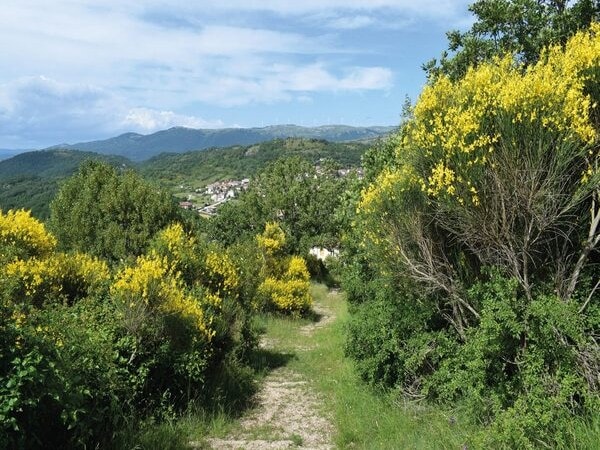
About thirty years earlier, on 27 October 1947, a special path was inaugurated with great solemnity and religious fervour: the Via Matris, a 750-metre long path that leads pilgrims from the Sanctuary to the place that the memory of a divine event has transformed into a centre of faith and spirituality: the Chapel of the Apparitions.
The Path
The Via Matris, with its seven stations, represents a journey of contemplation and meditation on the life of Mary, mother of Jesus, and her seven sorrows. It is the path to the heart of a mother who patiently and lovingly accepted the mysterious divine plan for her life, a journey of faith and sacrifice that led to the redemption of humanity. Each station is a moment of profound reflection on Mary’s suffering and love, an invitation to contemplate the strength and grace of the one chosen by God to be the mother of the Savior, from the moment she accepted Simeon’s prophecy to the moment she received the tortured body of her son. Each station is identified by a shrine that visually narrates one of Mary’s sorrows.
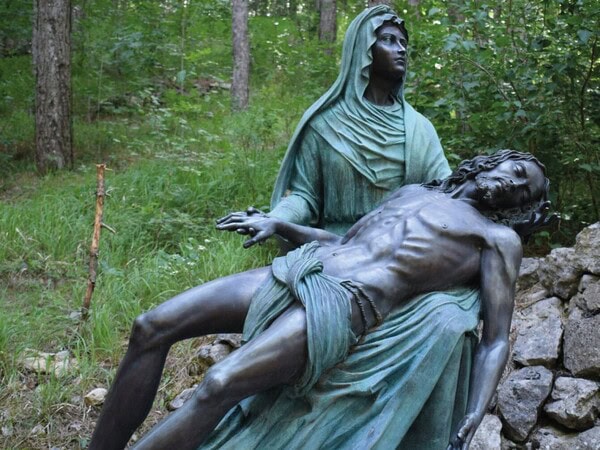
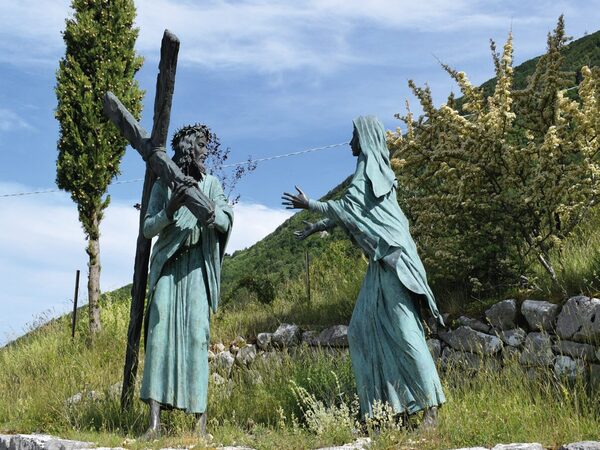
During the 1990s, the artist Alessandro Caetani created seven wonderful life-size sculptural groups that reproduce the same scenes portrayed in the aedicules, significantly enriching the representation of the Gospel story to the point of emotionally affecting all the faithful who walk the path.
The Sanctuary of Castelpetroso is the starting and ending point of a journey of spirituality and maternal love. Here, amid sacred chants and the scent of incense, devotees gather to honor Mary and ask for her protection.
The Seven “Bitterest” Sorrows
There are various interpretations of the “seven sorrows” or “seven swords” that wounded the Virgin’s heart. According to the most recent ones, these are not limited to episodes of the Passion but refer to Mary’s entire life and therefore also include events from Jesus’ childhood.
The origins of this particular religious journey are unknown and likely have roots in the Hispanic peninsula. It certainly arose from the example of the Via Crucis, which arose in the late Middle Ages following the revival of pilgrimages to the Holy Land and the desire of the faithful to reproduce in their own country the sites of Jerusalem and Christ’s journey to Calvary.
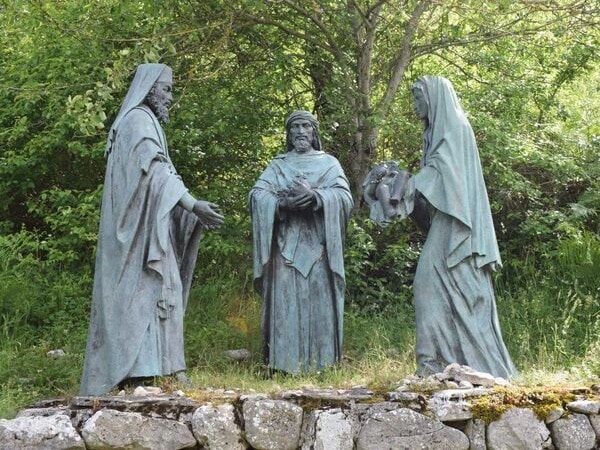
The Via Matris is a way of participating, through the contemplation of the Mother’s pain, also in the Passion of Christ. Since Jesus’ journey from Pilate’s tribunal to Mount Calvary was also traveled by Mary, accompanied by the pious women, some stations coincide.
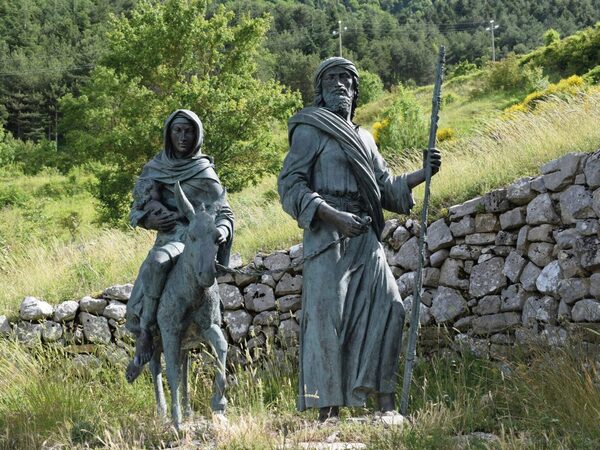
Thus, in the heart of the Molise mountains, the Via Matris continues to be walked by thousands of devotees who become witnesses to the faith and also to the charm that this sacred place emanates.