
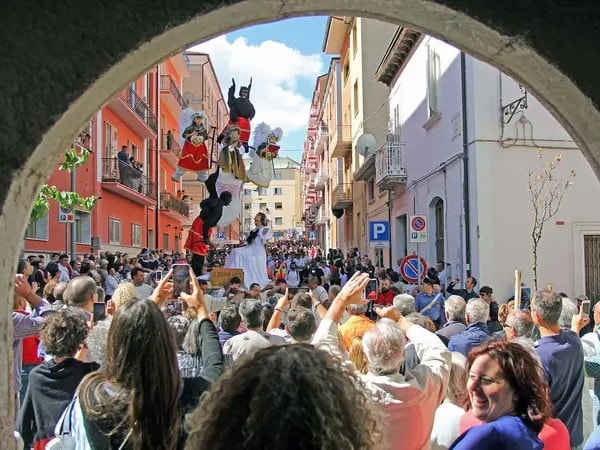
Each year on the Sunday of Corpus Christi, the streets of Campobasso become the stage for one of Italy’s most distinctive religious and cultural celebrations: the Festival of the Mysteries (I Misteri). Part procession, part performance, and part act of devotion, the event draws thousands of visitors who gather to witness what appears, at first glance, to be the impossible—angels, saints, devils, and other sacred figures floating above the crowd.
History & Allegory
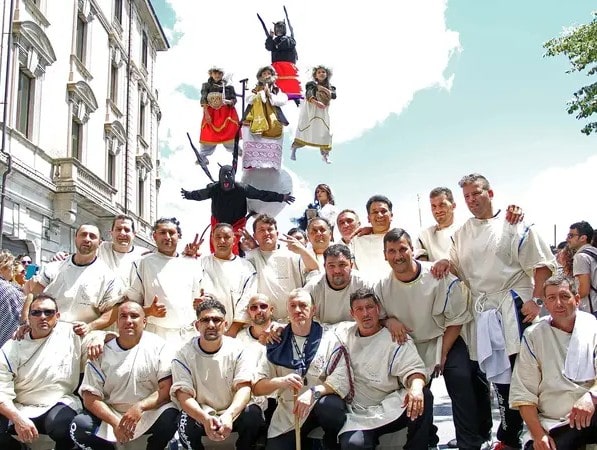
The tradition dates to 1740, when local artist and sculptor Paolo Saverio Di Zinno was commissioned to create a series of moving religious tableaux for the city’s Corpus Christi celebrations. Rather than relying on static floats, Di Zinno designed intricate iron frameworks capable of supporting children and adults dressed as biblical and saintly figures. Hidden beneath flowing costumes and decorative elements, the structures create the illusion that participants are suspended in midair.
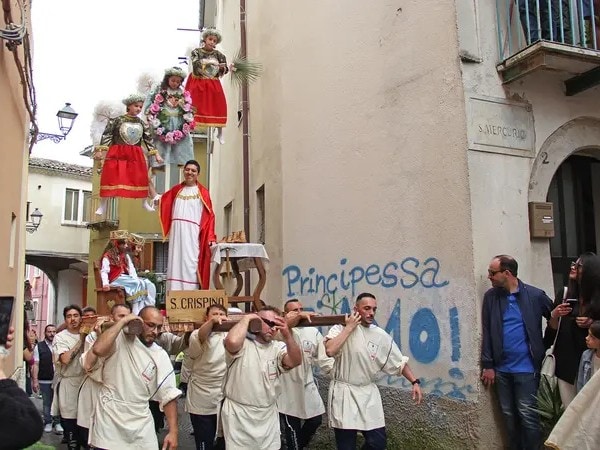
Although the original procession featured many more scenes, thirteen Mysteries survive today. Each represents a different religious theme and is carried through the city by teams of bearers who shoulder the weight of the structures along a route that winds through Campobasso’s historic center. The result is a striking blend of artistry, engineering, faith, and endurance. As the Mysteries move through the streets, spectators witness living works of art that have remained remarkably unchanged for nearly three centuries.
Living Tradition
What makes the Festival of the Mysteries especially meaningful is the way it connects generations. Families participate as performers, bearers, musicians, organizers, and spectators, often maintaining roles that have been passed down for decades. Children who once appeared as angels frequently return as adults to carry the structures themselves. The festival is therefore not merely a historical reenactment but a living tradition sustained through community participation and collective memory.
Today, the Mysteries remain one of Molise’s most recognizable cultural symbols. They embody the region’s ability to preserve tradition while continuing to bring people together in shared celebration. For visitors, the sight of figures soaring above the streets is unforgettable. For the people of Campobasso, however, the festival represents something even more enduring: a community carrying its history forward, quite literally, on its shoulders.
Route & More Information:
Above is a map of the route taken by the Corpus Christi Procession. The procession begins at the Museum of the Mysteries, then passes through the historic center and the city’s main streets before finally returning to the museum.
For readers interested in learning more about each of the thirteen surviving Mysteries, detailed descriptions and historical information can be found through the official resource maintained by the Association Misteri e Tradizioni.
References
- Digital History. (n.d.). The Mysteries of Campobasso. University of Teramo. https://digitalhistory.unite.it/en/themes/festivals/campobasso/
- (n.d.). Mysteries of Campobasso. https://italea.com/en/eventi/mysteries-campobasso/
- Italy by Events. (n.d.). Celebration of the Mysteries in Campobasso. https://www.italybyevents.com/en/events/celebration-mysteries-campobasso
- Misteri e Tradizioni. (n.d.). I Misteri di Campobasso. https://www.misterietradizioni.com/misteri/
- Turismo in Molise. (n.d.). Mysteries of Campobasso. https://turismoinmolise.com/en/mysteries-campobasso/